How World War I Messenger and Sentry Dogs Helped on the Front Lines
British and Belgian forces used trained dogs to carry messages and stand watch when other communication failed, relying on their natural alertness in the chaos of battle.
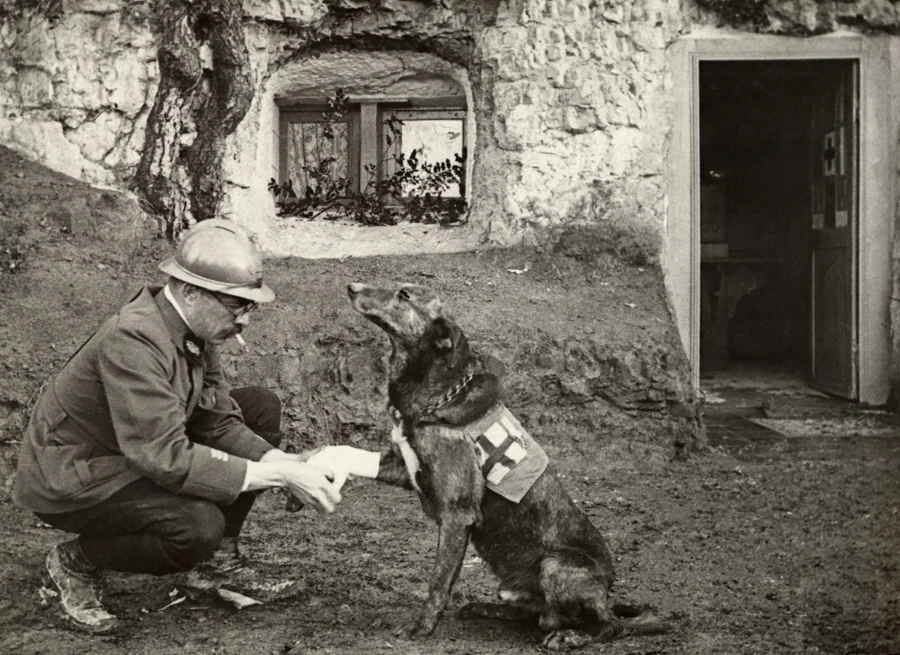
A WWI allied soldier bandages the paw of a Red Cross working dog in Flanders, Belgium, May 1917. Archival photograph by Harriet Chalmers Adams. Photographes du National Geographic · Public domain · Web size optimized; source linked for the original.
During the First World War, armies on the Western Front faced broken telephone lines, impassable terrain, and constant danger. In response, British and Belgian forces turned to dogs for practical help. Lt. Col. Edwin Hautenville Richardson established a British War Dog School that trained and supplied messenger, sentry, and ambulance dogs. These animals worked under fire, carrying dispatches or alerting soldiers to nearby threats. Contemporary accounts describe their usefulness without romanticizing the grim conditions of trench warfare. While popular stories sometimes highlight extraordinary sensory feats, the available records focus mainly on training based on trust and the dogs’ practical performance in specific roles. This article examines what the primary sources actually show, what remains uncertain, and what questions the evidence still raises about animal welfare in wartime.
Establishing the British War Dog School
Lt. Col. Edwin Hautenville Richardson played a central role in organizing the use of dogs by British and Allied forces. In his 1920 book British War Dogs, he describes how he set up a dedicated training school. The goal was to prepare animals for messenger, sentry, and ambulance duties. Training emphasized building trust between dog and handler rather than using harsh methods. This approach reflected Richardson’s belief that reliable performance came from cooperation, not fear.
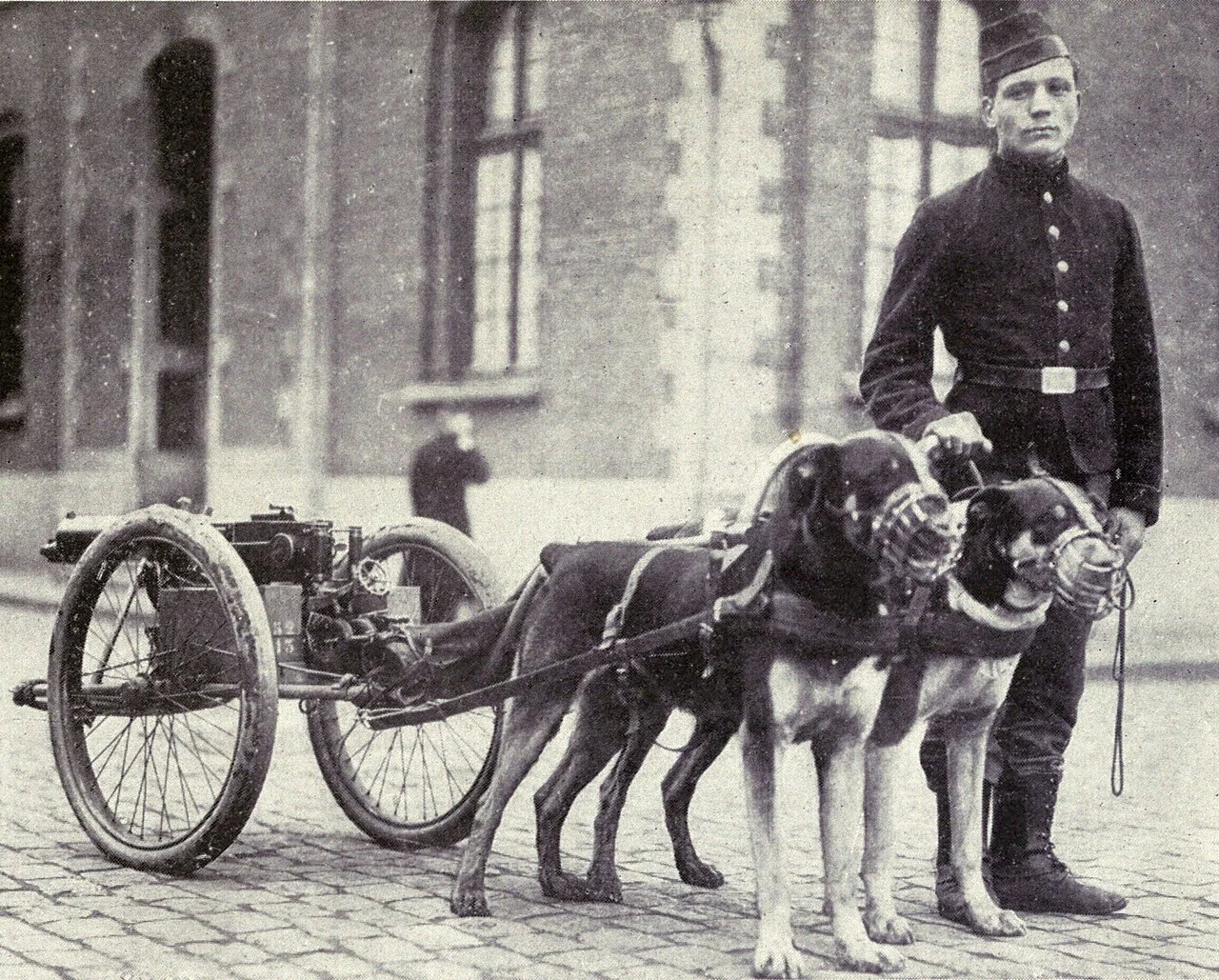
The school supplied dogs to units operating on difficult ground where runners and telephone wires often failed. Richardson reproduced official reports and handler accounts showing that the program grew in response to frontline needs. Belgian forces, by contrast, first used dogs mainly to pull machine-gun carts during the early retreat from Liège. Later, their focus shifted toward sentry and messenger work in France, though limited by available breeds and terrain. These details come directly from translated documents and officer letters included in Richardson’s text. The evidence does not support sweeping claims about ancient war hounds or universal sensory superiority; instead it offers a narrower picture of practical wartime adaptation.
One of Major Richardson's Ambulance Dogs working with the late R.A.M.C. Volunteers at Aldershot Unknown authorUnknown author · Public domain. Web size optimized; original linked.
Messenger Dogs Carrying Dispatches Under Fire
One of the clearest documented roles was that of the messenger dog. When barrages cut telephone lines and made human runners too vulnerable, dogs carried written dispatches across exposed ground. Handler reports reproduced by Richardson describe successful runs covering roughly 4,000 yards or even longer distances. These accounts note that the dogs kept going despite shelling and poor visibility. The 1918 Aberdeen Evening Express quoted Richardson on their effectiveness when other communication channels collapsed.
Such missions were dangerous. Dogs faced the same artillery, mud, and gas that endangered soldiers. Yet the records indicate they sometimes succeeded where humans could not. The BBC report on newly available 1916 newspaper records confirms that up to 20,000 dogs were trained for various British front-line duties, including message carrying. These figures come from War Office and contemporary press summaries. The evidence does not detail exact success rates across the whole war, nor does it claim dogs replaced all other communication. It simply shows they filled a gap when conventional methods failed.
Sentry Dogs and Their Quiet Alerts
Sentry or watch dogs were trained to detect approaching threats without unnecessary noise. A 1916 newspaper report quoted in the BBC article explains: “A watchdog never barks; at the most he will use a low growl to indicate the presence or approach of a hostile force. More often than not the mere pricking of the ears or the attitude of expectancy is sufficient to put his master on his guard.” This description highlights the value of subtle signals over loud barking that could reveal a position.
These dogs worked at night or in forward positions where surprise attacks were a constant risk. Their presence gave soldiers extra warning time. Richardson’s book and the contemporary newspapers both treat sentry work as a standard part of the program. However, the sampled sections do not provide technical explanations of superior hearing or smell. The emphasis is on observed behavior and the bond between dog and keeper. This leaves open questions about exactly which sensory cues mattered most in the noisy, smelly environment of the trenches.
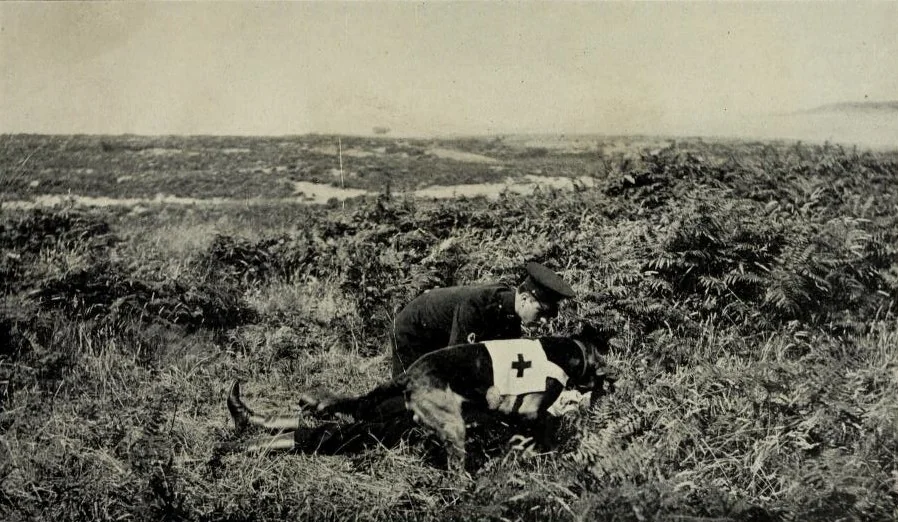
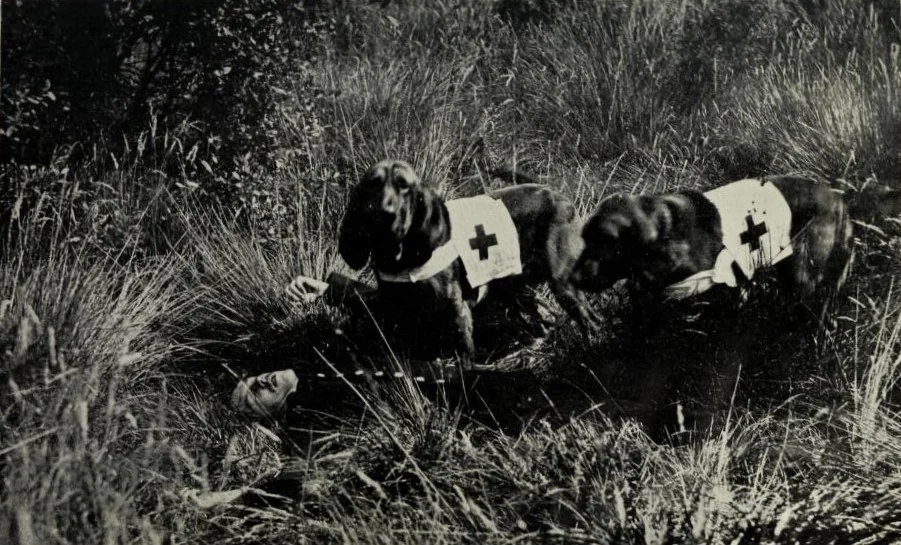
Major Richardson's Ambulance Dogs finding the wounded (taken in Aldershot), c. 1910. A historical training photograph of British war dogs used on the front lines. Unknown authorUnknown author · Public domain. Web size optimized; original linked.
Ambulance and Mercy Dogs in the Records
Some dogs were assigned to carry aid to wounded soldiers or help locate them. The BBC summary of 1916 records lists “carrying aid to wounded” among the roles. French Red Cross mercy dogs are mentioned in the same reporting as finding injured men, though British methods receive less detail. Richardson’s book refers to ambulance dogs but the sampled sections do not include explicit discussion of keen noses used for locating casualties or detecting gas.
The evidence therefore supports the existence of these duties while remaining silent on specific sensory techniques. This gap matters. Without clear contemporary descriptions of how the dogs were guided to the wounded, it is difficult to separate practical training from later storytelling. The records do show that handlers relied on trust and repetition rather than punishment. That training philosophy appears consistently across both the primary book and the newspaper accounts reviewed by the BBC.
What the Evidence Leaves Uncertain and Why It Matters
Reading the available sources raises several questions. How many dogs actually survived their service? What happened to them after the armistice? The texts mention training numbers and some successful missions but do not provide comprehensive casualty figures or long-term outcomes. Richardson stresses humane methods, yet the realities of artillery, poison gas, and exposure must have taken a toll. Modern readers might ask whether the benefits to military operations justified the risks to the animals. The evidence supports the existence of the program and some documented successes; it does not settle ethical debates.
Another uncertainty concerns sensory advantages. While popular accounts often credit dogs with almost miraculous noses and ears, the primary texts sampled here focus more on behavior and reliability than on physiology. The 1916 newspaper description of pricked ears and expectant posture is observational rather than scientific. This leaves room for interpretation. Was the dogs’ greatest contribution their persistence under fire, their quiet vigilance, or something else? The sources invite further research into archival handler logs or veterinary reports that may still exist. They also remind us that wartime animals were treated as tools as well as companions, a tension worth remembering.
Belgian dogs trained to draw quick-firing guns, World War I. Archival photograph of draught dogs pulling a machine-gun cart. W. E. Mason · Public domain. Web size optimized; original linked.
AI-assisted original writing. This feature was revised against source material and checked for unsupported claims. Follow the references below for evidence and its limits.
Royal charters set rules for restraining dogs to protect game, while hunting manuals later recorded the calls and names used by those who followed hounds on the trail.
Evidence from Saqqara and Asyut shows that dogs and other canids were mummified in large numbers as votive offerings connected to the gods Anubis and Wepwawet.
 Historical collection image