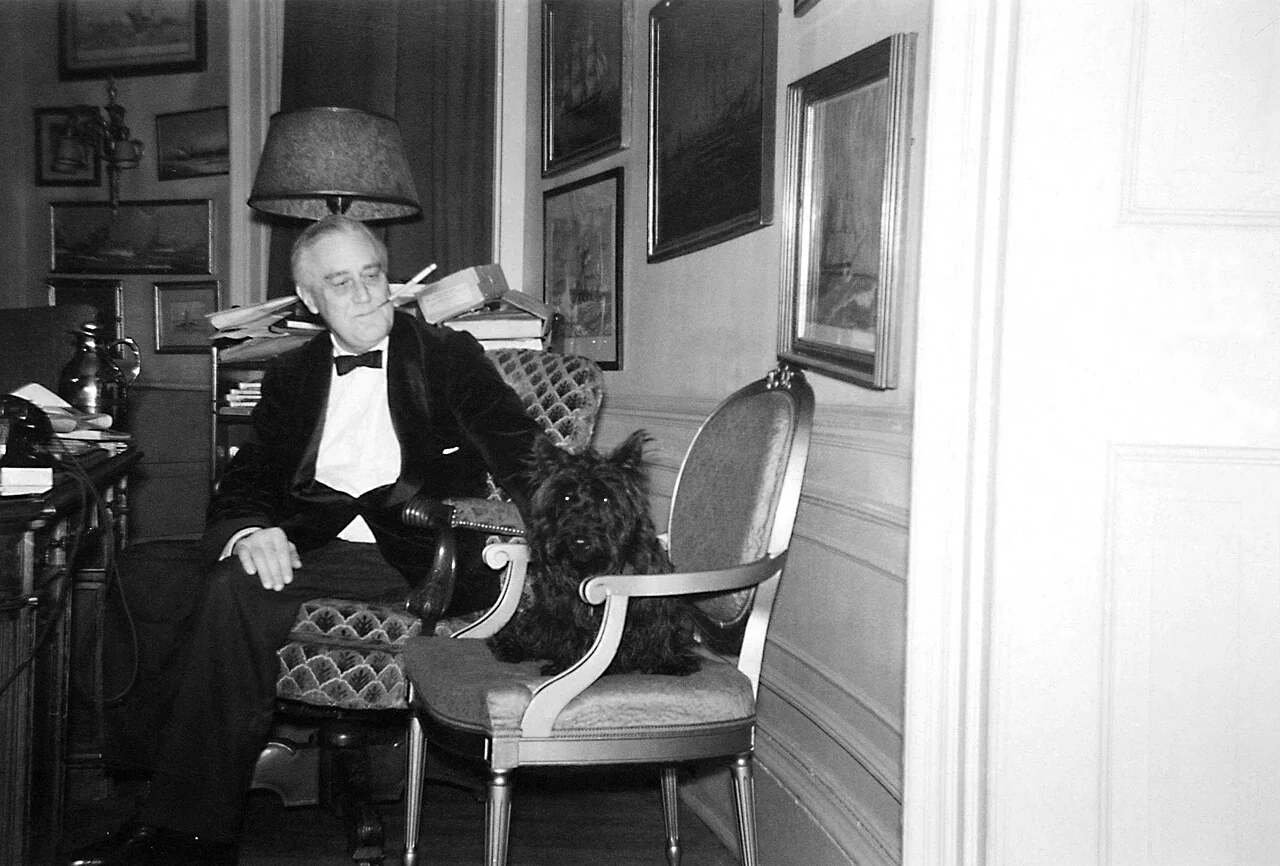
Franklin D. Roosevelt and Fala in the White House study, December 1941. Franklin D. Roosevelt Library · Public domain · Web size optimized; source linked for the original.
Some dogs get a favorite chair. Fala got a place beside a president in a national memorial. The Scottish terrier who accompanied Franklin D. Roosevelt was small enough to sit in his lap, yet familiar enough to become part of the president’s public image. His story has the ingredients of an excellent dog tale: an extravagant name, a famous household and a friendship that outlasted the cameras. The best part is that the historical record offers plenty to enjoy without giving Fala imaginary speeches of his own. A dog can be interesting without being appointed an unofficial political adviser.
A Terrier Joins the White House
The Franklin D. Roosevelt Presidential Library records Fala’s birthday as April 7, 1940. He was a gift from Mrs. Augustus Kellogg, passed to Roosevelt through the president’s cousin Margaret Suckley. The puppy went to live at the White House on November 10 that year. That is quite a change of address for a dog whose first birthday was still months away.
His full name was Murray the Outlaw of Fala Hill. The library uses that spelling; the National Park Service renders the final part as Falahill. Either way, it is an impressively large name for a Scottish terrier. Fortunately for everyone calling him, Fala was available as a shorter everyday option.
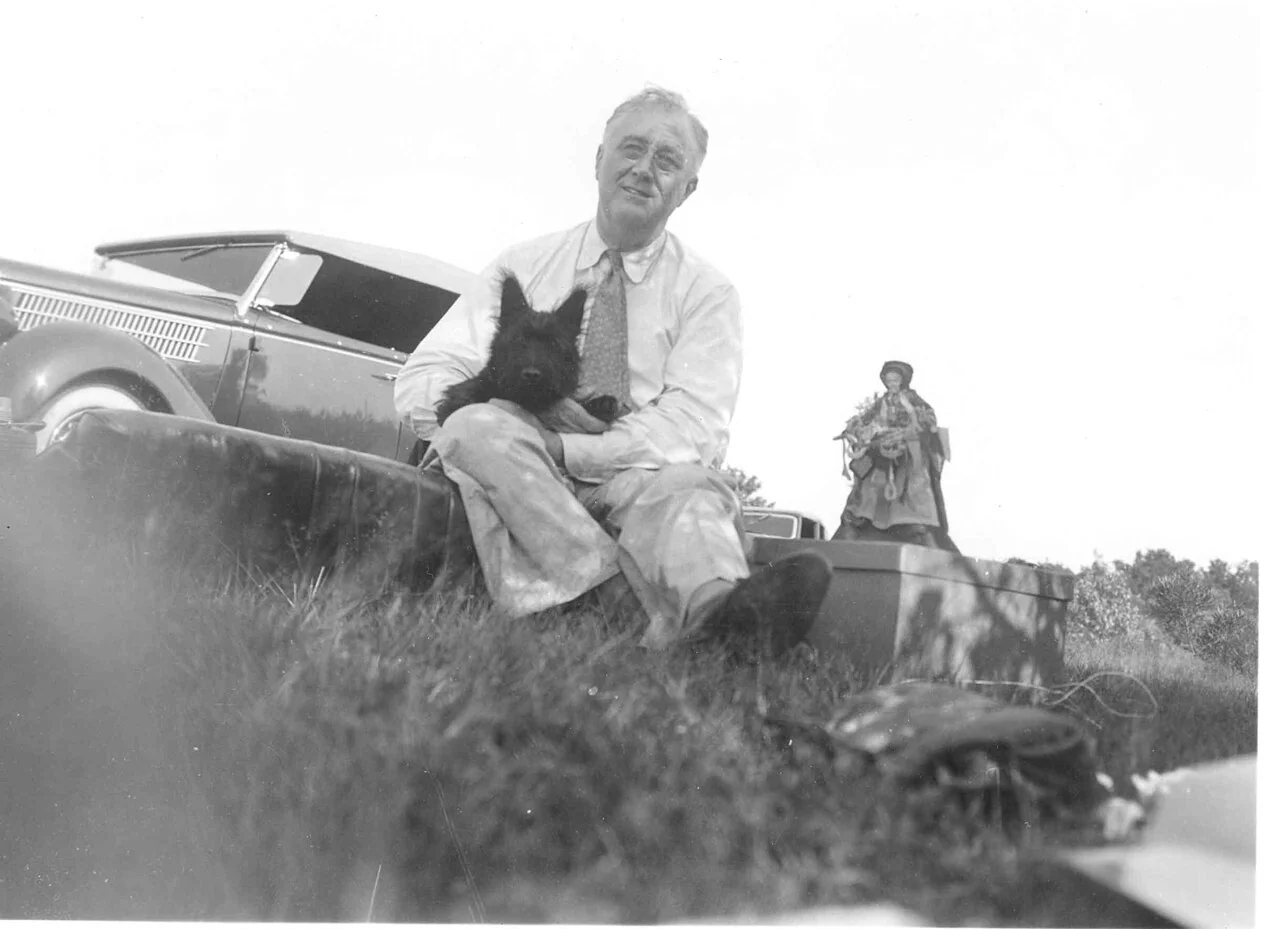
Four-month-old Fala with Franklin D. Roosevelt at a picnic near Pine Plains, New York, August 1940. FDR Presidential Library & Museum · CC BY 2.0. Web size optimized; original linked.
The Companion Behind the Public Image
Fala was not Roosevelt’s first dog. The presidential library describes several earlier canine companions, including other Scottish terriers. What set Fala apart was his close association with the president during the remaining years of Roosevelt’s life. The library calls him a constant companion, while the National Park Service describes frequent photographs of the pair in and around the White House.
Those photographs are a useful way into the story. One image identified by the Park Service shows Roosevelt holding four-month-old Fala during a picnic near Pine Plains, New York, in August 1940. A small dog in someone’s lap is a familiar sight. Here, the someone happened to be president.
When a Dog Became Part of a Speech
Fala’s public life extended beyond photographs. The National Park Service notes his appearance in an MGM documentary about a day at the White House. He also became the subject of Roosevelt’s well-known Fala speech to the International Teamsters Union on September 23, 1944. In responding to political attacks, Roosevelt brought his dog into the argument with a joke.
There is no need to pretend Fala understood the campaign to appreciate the moment. The humor depended on the audience recognizing him as a beloved pet. A president could seem more approachable when the conversation turned, however briefly, to the little dog at his side. That is an observation about the speech, rather than a claim about what the terrier thought of it.
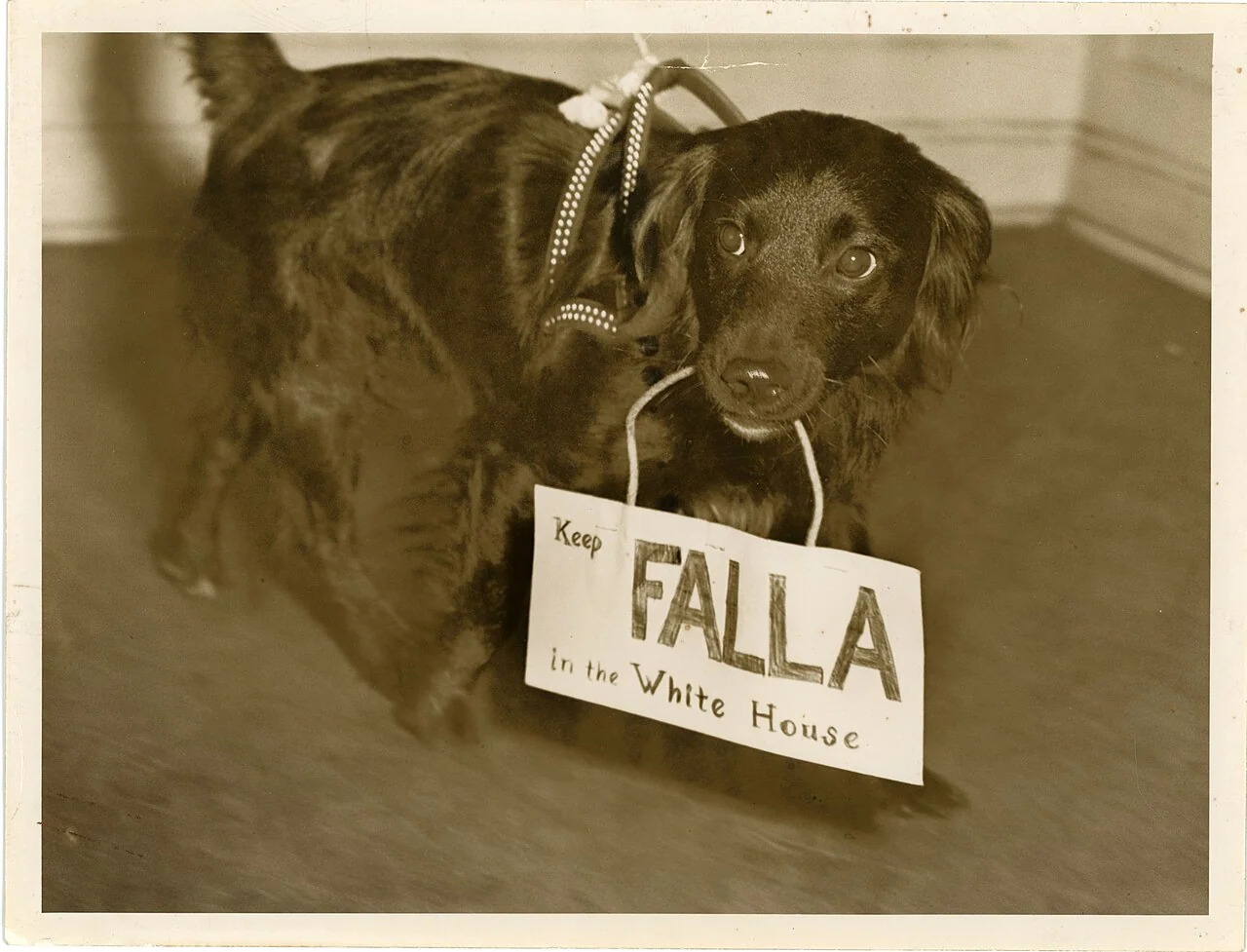
1944 campaign photograph of Fala the Scottish Terrier with a sign reading "Keep FALA in the White House." FDR Presidential Library & Museum · CC BY 2.0. Web size optimized; original linked.
Life After Roosevelt
After Roosevelt died in April 1945, Fala lived with Eleanor Roosevelt at Hyde Park, New York. The dog died in 1952. The presidential library places his burial near the sundial in the estate’s Rose Garden, where Franklin and Eleanor Roosevelt are also buried.
This part of the story brings the scale back down from national politics to a household and its dog. Fala’s connection with the family continued after the presidency ended. For readers following his trail, Hyde Park and the memorial in Washington tell different parts of that same life: one is a family resting place, the other a public remembrance.
A Small Figure Worth Noticing
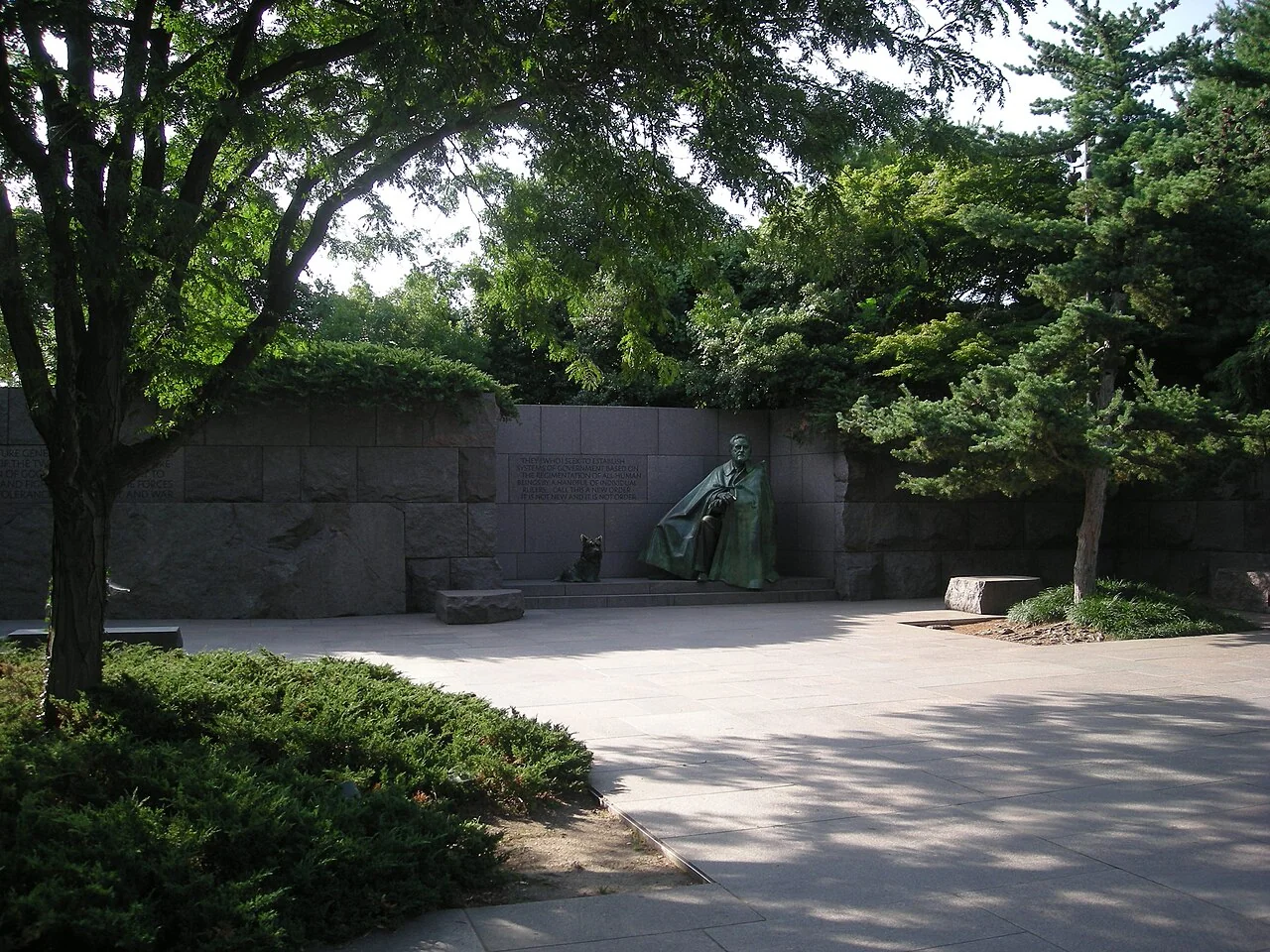
At the Franklin Delano Roosevelt Memorial in Washington, D.C., a bronze Fala sits beside the president. The National Park Service credits sculptor Neil Estern with the figures. Its account explains that Senator Carl Levin requested the addition of the dog to show Roosevelt’s human side.
It is a lovely detail to pause over. Memorials ask us to think on a grand scale; a terrier invites us to look a little closer. Fala does not need an invented thought bubble or an exaggerated adventure to earn that attention. The documented story is warm enough: a gift, a companion and a small dog remembered beside the person he so often accompanied.
The statues of Franklin D. Roosevelt and Fala at the Franklin Delano Roosevelt Memorial, photographed in August 2014. Michael Barera · CC BY-SA 4.0. Web size optimized; original linked.
AI-assisted original writing, checked against the official source pages linked below. Historical photographs and further details are available in those collections.
Royal charters set rules for restraining dogs to protect game, while hunting manuals later recorded the calls and names used by those who followed hounds on the trail.
Evidence from Saqqara and Asyut shows that dogs and other canids were mummified in large numbers as votive offerings connected to the gods Anubis and Wepwawet.
 Historical collection image