How Corporate Matching Gifts Can Multiply Your Support for Animal Rescues
Employee donation programs at many large companies can double or triple contributions to qualifying shelters and breed-specific health groups, stretching each gift further for animal care.
Many people who care about dogs look for ways to make their charitable gifts go further. Corporate matching gift programs, offered by a range of large employers, provide one straightforward way to do exactly that. When an employee donates to an eligible animal rescue or nonprofit, their company may add an equal or greater amount. The result is that one personal contribution can become two or even three times as much. This mechanism quietly amplifies support for organizations that help dogs, though success depends entirely on the specific policies of each employer and the initiative of the employee. The following sections explore how these programs work, which companies participate, what animal groups benefit, and some practical steps to consider. Light editorial observations are included to help readers weigh the real-world value without overstating outcomes.
What Corporate Matching Gifts Actually Do
Corporate matching gifts are a form of philanthropy in which a company agrees to match an employee's personal charitable donation with a contribution of its own. The typical ratio is one-to-one, meaning a $100 gift from an employee prompts the company to give another $100 to the same nonprofit. Some programs go higher, occasionally reaching two-to-one matches in which the company's gift doubles the original amount. These programs are not automatic. The employee must usually initiate the request through their human resources department or an online portal, and the nonprofit must qualify under the company's guidelines. Evidence from multiple sources confirms that such matches have been applied to donations supporting dog rescues and breed-specific health initiatives.
From an editorial perspective, this structure rewards employees who take the time to check their benefits. It turns an ordinary act of giving into something that can have noticeably larger impact, though there is no guarantee every donation will be matched. The process highlights how private-sector policies can quietly support animal welfare without requiring new legislation or public campaigns. Readers might ask themselves: does my own employer participate, and if so, how often do I take advantage of it? The uncertainty lies in the variability—each company's rules on minimums, maximums, and eligible causes differ, so the benefit is real but not universal.
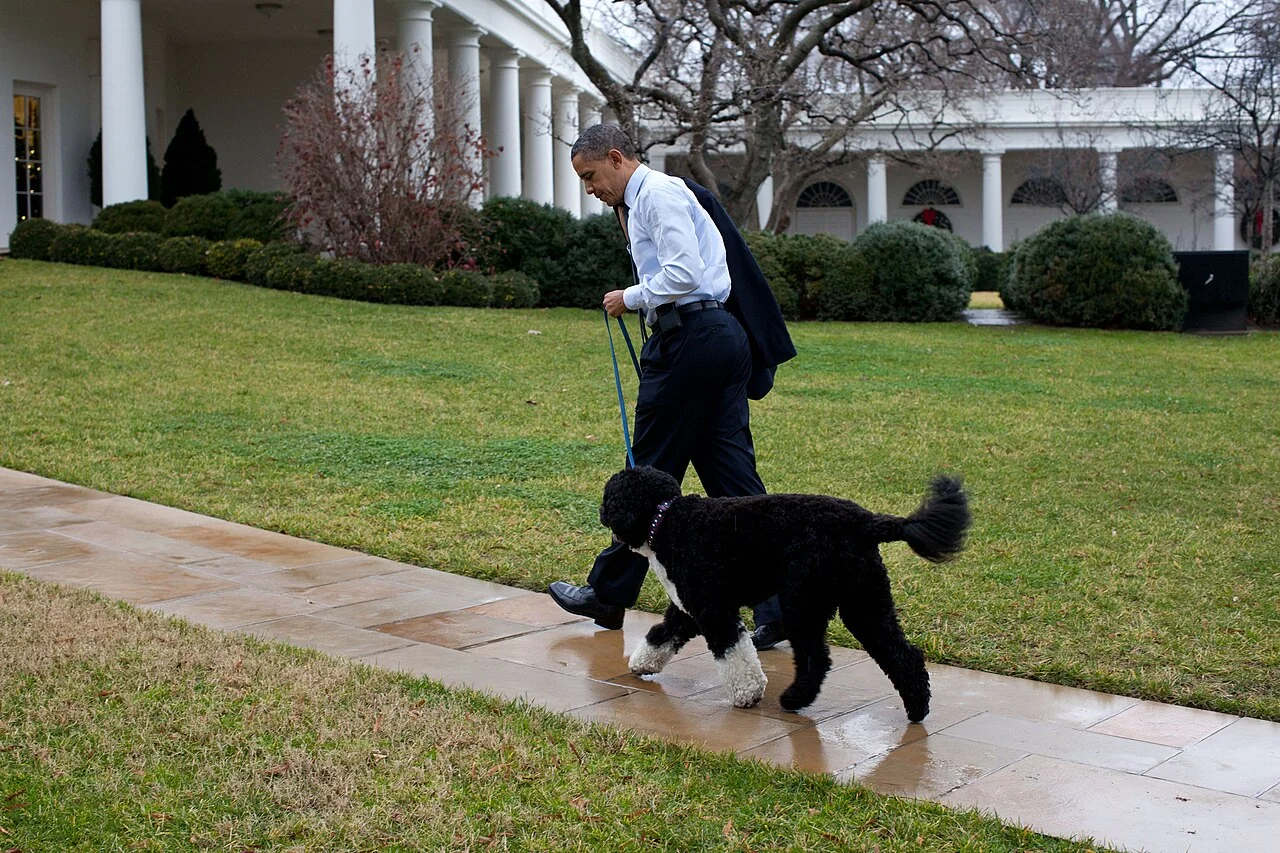
President Barack Obama walks toward the Oval Office with Bo, the Obama family dog, after returning from a Christmas shopping trip, Dec. 21, 2011. The White House · Public domain. Web size optimized; original linked.
Companies Known to Match Donations to Animal Nonprofits
Several large corporations have matching gift programs that have been used to support animal-related organizations. Johnson & Johnson, for example, appears in multiple reports as a participant, sometimes offering matches at a one-to-one ratio or higher depending on the specific plan. Other companies listed in connection with animal welfare donations include Kimberly-Clark, Aetna, Verizon, Merck, 3M, Abbott Laboratories, AT&T, ExxonMobil, Eli Lilly, FedEx, Kaiser, AbbVie, Microsoft, Apple, Disney, Bank of America, and Coca-Cola. Pet-industry firms such as those tied to Pets Best Insurance, Hill's Pet Nutrition, Blue Buffalo, and ADM Animal Nutrition also maintain programs that can match gifts to qualifying 501(c)(3) animal rescues.
These matches are not limited to any single type of animal group. Evidence shows they have benefited general dog rescues as well as organizations focused on the health of specific breeds. Editorial analysis suggests this diversity is useful: employees at different firms can direct their matched gifts toward causes they personally value most, whether that is local shelter operations or research into genetic conditions in dogs. A practical question for readers is whether their own workplace is on any of these lists and, if not, whether they might advocate for adding animal welfare to their company's eligible causes. Humorously, one might imagine a particularly devoted dog owner submitting a polite but persistent request to HR—though in reality the process is usually handled through standard forms rather than heartfelt pleas.
How Animal Rescues and Breed Groups Benefit
Organizations such as PAWSibilities Animal Rescue have received corporate matching gifts that increase the total funds available for their work with dogs. The same is true for the SCWTCA Endowment, which supports health research and testing for Soft Coated Wheaten Terriers. These groups are recognized as 501(c)(3) nonprofits, a status that makes them eligible for many corporate programs. The additional money can help cover general operating needs, though specific uses such as kennel upgrades, food supplies, or medical care are not itemized in the available evidence.
The editorial takeaway is that matching gifts function as a quiet multiplier. A single employee donation that might have purchased a modest amount of dog food can, when matched, support a larger share of the organization's budget. This matters because animal rescues often operate on tight margins. One useful question to consider is how transparently these organizations report the impact of matched gifts. While the evidence does not detail exact allocations, the fact that multiple rescues actively promote these programs suggests they view them as genuinely helpful. An invented satirical scenario might involve a dog shelter throwing a 'thank you' party for corporate matching departments, complete with tennis-ball centerpieces—clearly fictional, offered only for levity and not as a real event.
Soft Coated Wheaten Terrier at the City of Birmingham Championship Dog Show, 2003 (documentary photograph) sannse · CC BY-SA 3.0. Web size optimized; original linked.
Steps Employees Can Take to Activate Matches
The process typically begins with the employee. Most companies require donors to submit a matching-gift request through their HR portal or a dedicated form after making the initial donation. Potential donors are encouraged to confirm whether their employer participates and what the current matching ratio and limits are. Evidence indicates that eligibility can extend in some cases to retirees or spouses, but this is determined solely by each company's policy.
A second practical step is to verify that the chosen animal nonprofit is an approved recipient. Both PAWSibilities and the SCWTCA Endowment explicitly mention accepting matched gifts, which can serve as a helpful starting point. Editorial analysis here is straightforward: the system places the responsibility on the individual employee, which can feel like an extra chore at the end of a busy workday. Yet the potential to double or triple impact makes the few minutes of paperwork worthwhile for many. Readers might usefully ask whether their company offers any additional incentives, such as volunteer grants, that could be combined with matching gifts. The uncertainty remains around approval rates—while many requests succeed, the sources emphasize that each company makes its own final decisions.
Broader Implications and Questions Worth Asking
Corporate matching programs illustrate how private philanthropy policies can support causes that matter to employees. When those causes involve dog rescues and health research, the result is more resources for animal welfare without additional cost to the individual donor. This model is not new, yet its application to animal nonprofits appears to be growing as more companies include them in eligible lists. The evidence supports the view that these programs can meaningfully increase total giving, though they rely on employee awareness and corporate commitment.
From an editorial standpoint, it is worth asking whether more companies should highlight their animal-welfare matches in the same way they publicize matches for education or disaster relief. Greater visibility might encourage higher participation rates. Another implication is the indirect benefit to corporate culture: employees who feel their workplace supports their values may experience higher morale. Light humor aside—imagine the office dog walking club also serving as an informal matching-gift support group—the real value lies in the tangible increase in funds for rescues. Readers could consider discussing these programs with colleagues or HR, or simply checking their own benefits portal this week. The evidence does not promise universal success, but it does show that when the pieces align, one gift truly can become two or more.
AI-assisted original writing. This feature was revised against source material and checked for unsupported claims. Follow the references below for evidence and its limits.

 Photograph